
Home Cement Procurement Insights

Cement Procurement Insights

Leading Cement Brands •
Institutional Supply •
Multiple States •
Factory-to-Site Dispatch •
Leading Cement Brands •
Institutional Supply •
Multiple States •
Factory-to-Site Dispatch •
KNOWLEDGE DIRECTORY

Jump Directly to Any Procurement Guide:

Matcon India provides direct, unabridged procurement intelligence and technical specifications for project developers, EPC contractors, and RMC plant operators. Select any topic below to jump directly to its complete guide.

TECHNICAL GUIDE CEMENT GRADES

PPC vs OPC 43 vs OPC 53 — Which Cement Grade Does Your Project Need?

Understand structural characteristics, early strength vs ultimate durability, curing dynamics, and material cost optimization.

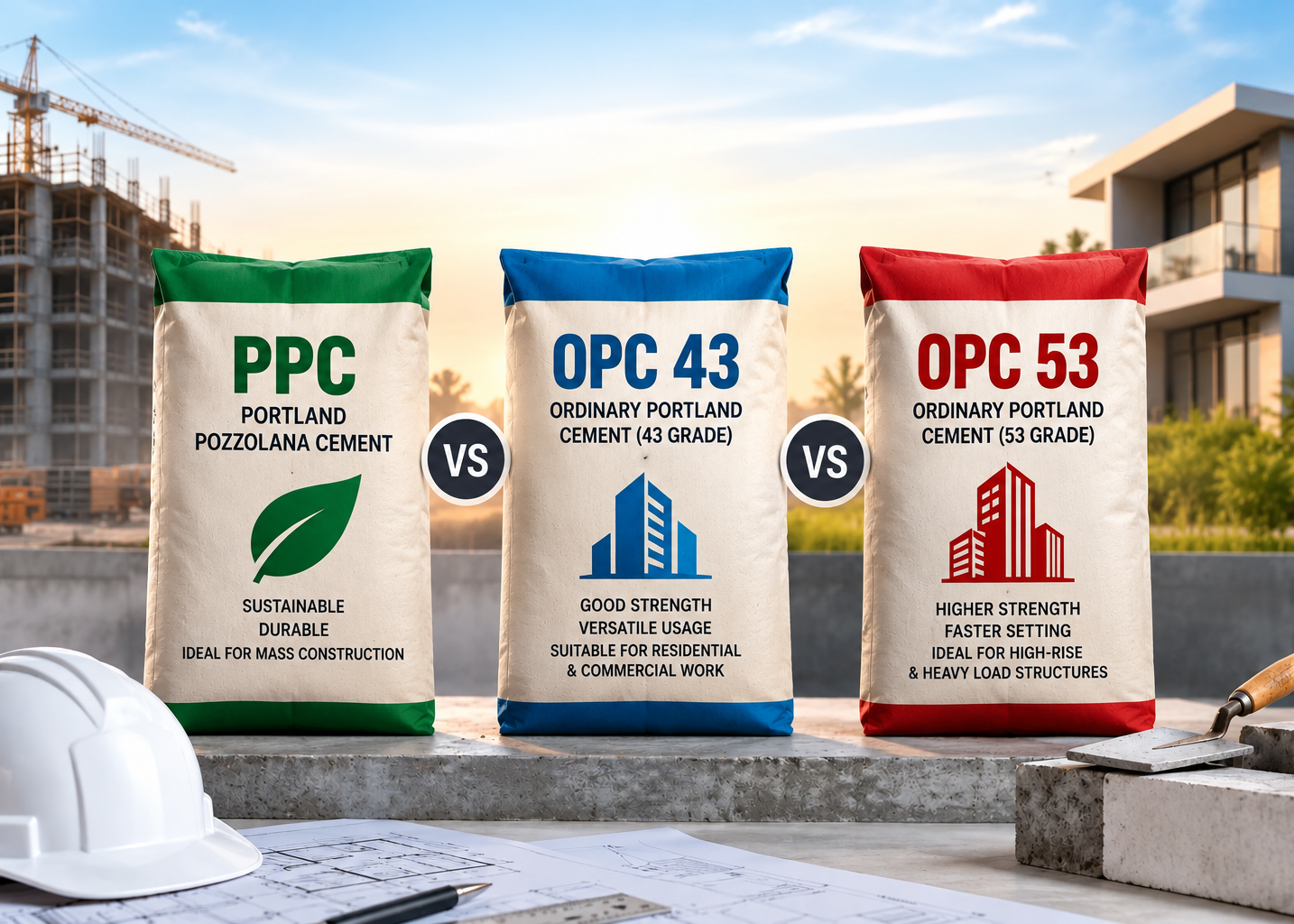
PPC vs OPC Cement

When planning a commercial, residential, or infrastructure development, choosing the correct cement grade is one of the most critical structural and economic decisions. A common misconception among site engineers and developers is that a higher numerical grade (such as OPC 53) is always superior for every application. In reality, modern concrete technology dictates matching the physical properties of the cement to the specific structural component.

1. Ordinary Portland Cement (OPC 53 Grade - IS 269)

OPC 53 is engineered to achieve a minimum 28-day compressive strength of 53 MPa (frequently achieving 58-65 MPa in premium brands). It demonstrates extremely rapid early strength development (typically 27 MPa within 3 days and 37 MPa by 7 days).

  • Ideal Applications: High-rise structural frames, heavily loaded RCC columns, shear walls, post-tensioned slabs, precast bridge segments, pre-stressed girders, and heavy industrial machine foundations.
  • Setting & Shuttering Benefits: Fast setting times allow rapid turnaround of formwork cycles, speeding up tower floor-to-floor cycle times from 12 days down to 6-8 days.
  • Precautions: OPC 53 generates substantial heat of hydration during early crystallization. Intensive, continuous water curing (minimum 7-10 days) is strictly mandatory; otherwise, thermal stress micro-cracks will appear on slab and beam surfaces.

2. Ordinary Portland Cement (OPC 43 Grade - IS 269)

OPC 43 is a versatile, moderate-strength cement with a 28-day target strength of 43 MPa. It exhibits a balanced heat of hydration curve and moderate initial setting rate.

  • Ideal Applications: Standard G+3 residential buildings, RCC road culverts, precast boundary walls, paving blocks, and standard non-critical structural members.
  • Why It Matters: It prevents the excessive cracking risk of OPC 53 in thinner structural elements while providing faster early setting than blended cements.

3. Portland Pozzolana Cement (PPC - IS 1489 Part 1)

PPC is produced by intergrinding OPC clinker with high-grade reactive pozzolanic fly ash (typically 15% to 35%) and gypsum. Rather than competing with OPC on 3-day strength, PPC creates a secondary hydration reaction where pozzolana reacts with free calcium hydroxide $[Ca(OH)_2]$ to form dense Calcium Silicate Hydrate (C-S-H) gel.

  • Superior Ultimate Durability: At 56 to 90 days, PPC's compressive strength matches or exceeds OPC 53. More importantly, it dramatically seals pore spaces, providing high impermeability against water seepage, chloride attacks, and aggressive chemical soils.
  • Reduced Heat of Hydration: Eliminates thermal contraction cracks in mass foundation rafts, retaining walls, and basement diaphragm walls.
  • Ideal Applications: Basement foundations, retaining walls, brick/block masonry, internal and external wall plastering, sewage pipelines, and coastal marine construction.
Matcon Procurement Insight for Project Cost Savings:

Smart developers utilize a dual-grade procurement strategy: Source OPC 53 for high-stress vertical columns, transfer girders, and primary RCC slabs, while specifying PPC for all basement rafts, boundary walls, brick masonry, and internal/external plastering. This not only increases structural impermeability and eliminates hairline wall cracks, but also saves between ₹15 to ₹28 per bag on non-structural cement off-take.

PROCUREMENT INTELLIGENCE MARKET DYNAMICS

Trade vs Non-Trade Cement — Understanding the Difference

How non-trade institutional channels differ from retail distribution in eligibility, direct billing, logistics, and bulk pricing economics.

Trade vs Non-Trade Cement

In the Indian cement manufacturing and distribution ecosystem, every bag leaving a manufacturing unit is strictly categorized as either Trade (Retail) or Non-Trade (Institutional / Direct Project). Confusing these two streams can cause project owners to overpay by lakhs of rupees per floor or inadvertently face billing stoppages.

1. What is Trade Cement? (The Retail Channel)

Trade cement is the commercial stock that circulates through stockists, wholesale dealers, and local neighborhood hardware shops. It is packaged in standard retail bags carrying maximum retail pricing (MRP) printing.

  • Target Audience: Individual Home Builders (IHBs), local renovation contractors, small repair jobs, and ad-hoc cash buyers.
  • Pricing Structure: Carries multiple supply chain overheads, including state distributor margins, secondary wholesale margins, local warehouse storage rentals, loading/unloading charges, and retail dealer promotional incentives.
  • Flexibility: High flexibility—you can purchase anywhere from 5 bags to 100 bags immediately on spot pickup.

2. What is Non-Trade Cement? (The Institutional Supply Channel)

Non-Trade cement is direct factory-to-site supply. When a real estate developer, EPC contractor, road builder, or RMC plant orders non-trade material, the invoice is generated directly by the cement manufacturing company (e.g. UltraTech, JK Cement, JSW) in the buyer's corporate GST name.

  • Cost Advantage: Bypasses the entire middle tier. The price is factory-direct (ex-works) plus direct road/rail freight, resulting in savings of ₹25 to ₹60 per bag compared to the prevailing retail market.
  • Minimum Order Quantity (MOQ): Dispatched only in Full Truckload (FTL) quantities—standard trailers carry 20 MT (400 bags), 25 MT (500 bags), or 40 MT (800 bags), or in bulkers carrying 25-35 MT.
  • Legal & Commercial Restrictions: Non-trade cement is explicitly marked "NOT FOR RESALE". It is legally earmarked exclusively for physical consumption at the specific project site or RMC batching plant approved in the customer master. Diverting or selling non-trade cement into retail shops is illegal under GST and manufacturer compliance rules.
How Matcon India Bridges the Institutional Gap:

Manufacturers typically hesitate to open direct customer codes for mid-sized builders or contractors requiring 500-2,000 bags a month due to sales desk administrative bandwidth. Matcon acts as an official institutional channel partner—we aggregate demand, coordinate corporate documentation, unlock Tier-1 non-trade pricing, and manage end-to-end plant dispatch scheduling for mid-to-large projects seamlessly.

COMMERCIAL GUIDE PRICING MECHANICS

How Institutional Cement Pricing Works

An in-depth look at plant base prices, freight calculations, customer code discounts, quantity brackets, and commercial payment terms.

Institutional Cement Pricing

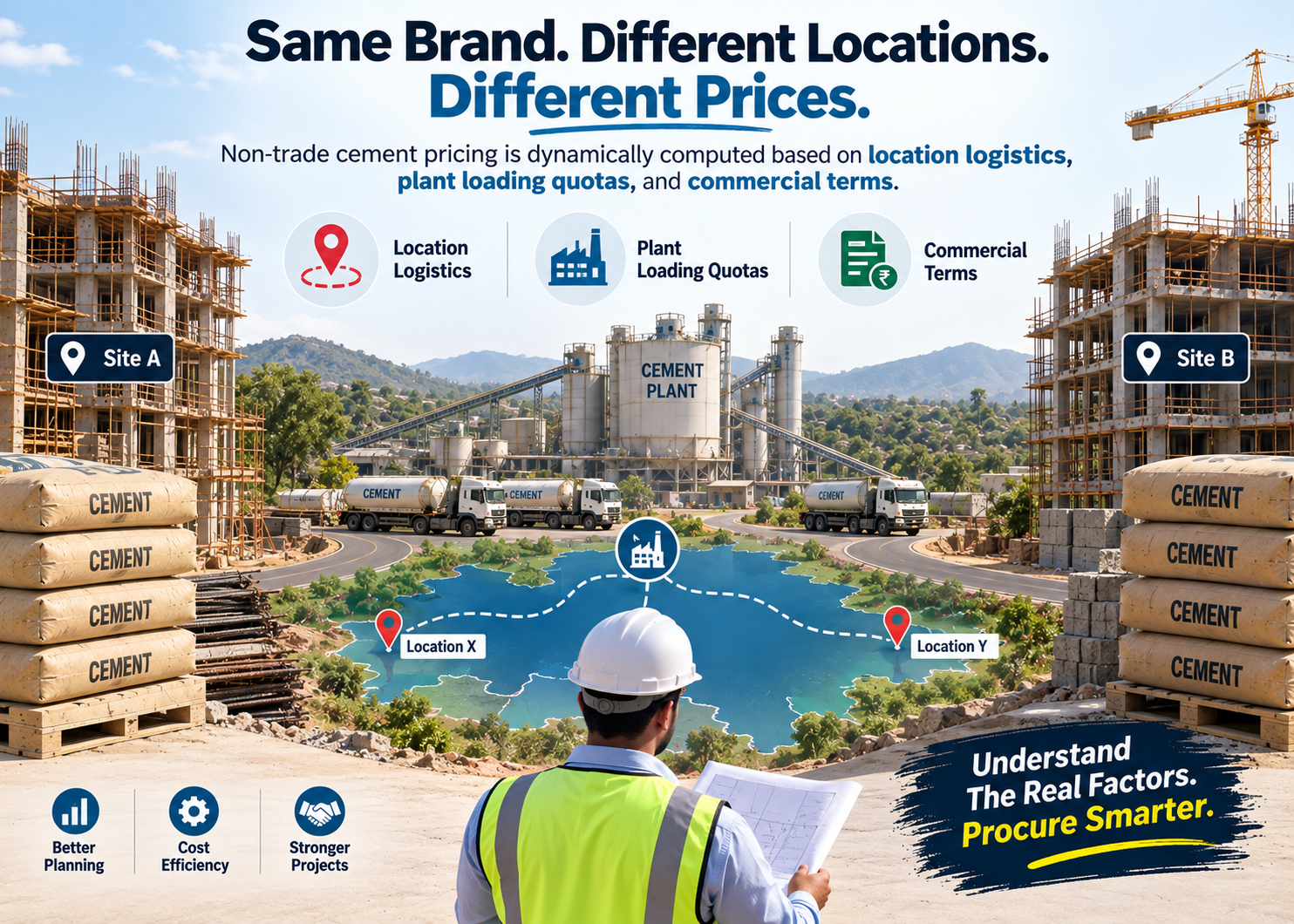
Project procurement heads frequently ask why cement rates vary between different locations in the same state, or why two neighboring construction sites receive different quotes for the same brand. Unlike retail goods with fixed MRPs, non-trade cement pricing is dynamically computed based on location logistics, plant loading quotas, and commercial terms.

The 4 Core Pillars of Landed Cement Pricing

  1. Ex-Works Plant Base Price: The bare production rate per metric ton set at the mother clinker plant or grinding unit. This fluctuates based on raw material costs (limestone royalties, imported petcoke, power tariff revisions) and plant inventory pressures.
  2. Primary Freight & Toll Logistics: The cost of transit from the plant to the destination site. Plant distance (e.g. 150 km vs 450 km) contributes ₹15 to ₹50 per bag to landed costs. Rail-fed destinations also incur siding handling, demurrage buffer, and local secondary road shuttle costs.
  3. Statutory Taxes & Duties: Cement in India attracts 28% GST plus local municipal entry cesses, green taxes, and environment compensation charges where applicable.
  4. Volume Tier & Customer Code Discounts: Manufacturers categorize customer accounts into monthly off-take tiers. A monthly consumption commitment of 2,000 MT commands special off-invoice commercial credit notes or upfront price deductions compared to a spot 50 MT order.

Billing Price vs Net Landed Price

A frequent pitfall for new buyers is evaluating quotes solely on the gross tax invoice rate. In institutional supply, manufacturers often utilize two pricing structures:

  • Net Landing Rate: An all-inclusive upfront rate per bag or per MT delivered directly to your site, with all volume discounts already factored into the invoice.
  • Gross Billing with Commercial Credit Notes: The invoice is issued at a higher list price, and the manufacturer later issues formal credit notes (post-audit, usually at month-end) for cash discounts, target achievements, or project subsidies.
Matcon's Transparent Commercial Commitment:

We operate strictly on clear, verifiable Net Landed Rates. We clarify all taxes, freight components, and payment modalities upfront so contractors never face unexpected credit note disputes or hidden demurrage charges.

DOCUMENTATION CHECKLIST COMPLIANCE

Documents Required for Opening a Cement Customer Code

A complete checklist of KYC, GST, project allotment, and commercial documentation needed to open a direct manufacturer billing code.

Documents for Customer Code

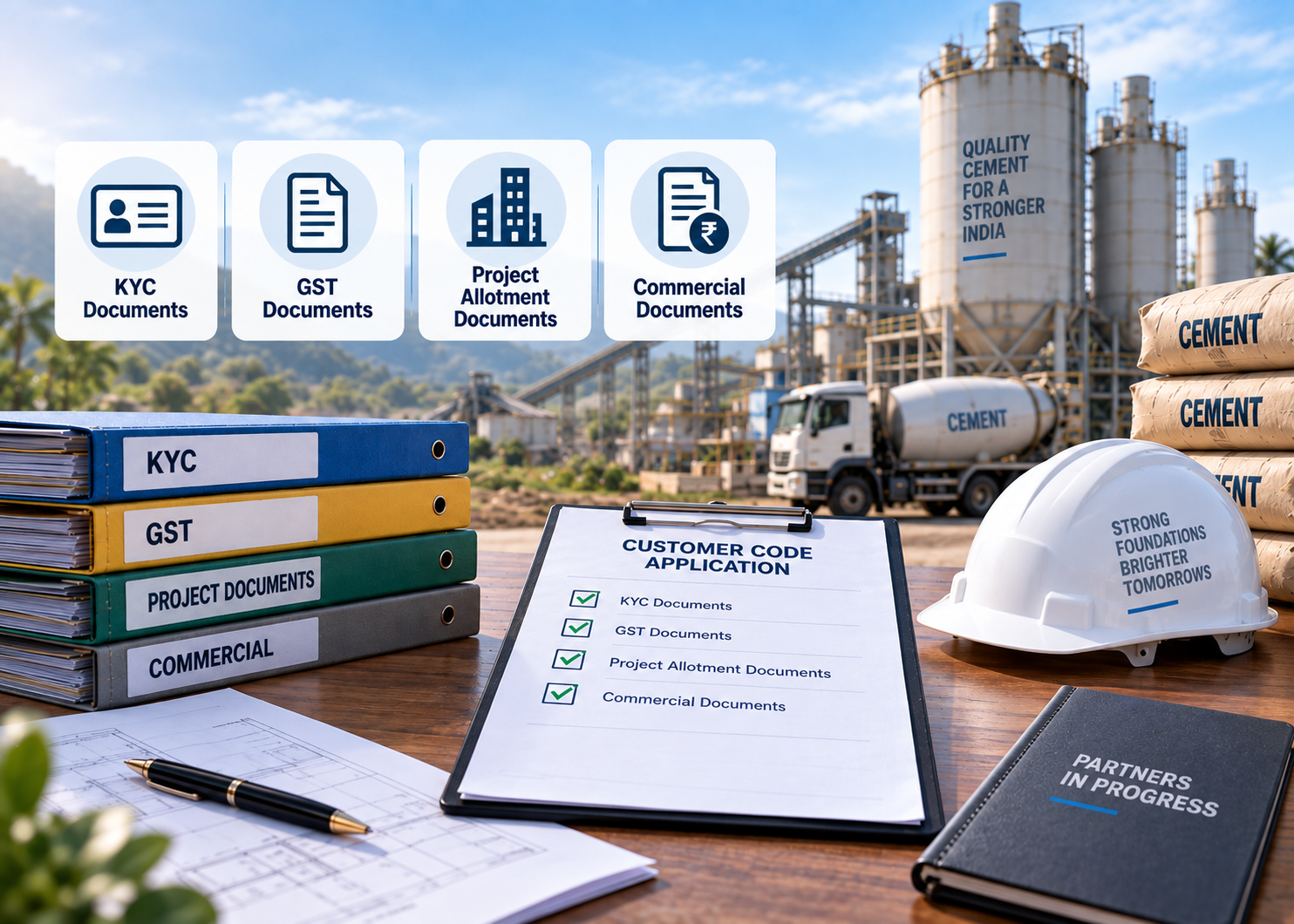
To buy cement under non-trade institutional pricing directly from major cement corporations (such as UltraTech, JK Cement, JSW, Ambuja, etc.), the first procedural step is creating a verified Customer Master Code in the manufacturer's SAP/ERP enterprise software. This code legally verifies your project, enables GST-compliant direct billing, and establishes your official dispatch shipping addresses.

Complete Master Checklist for Customer Code Opening

Keep the following scanned, self-attested documents ready to ensure rapid, same-day application processing:

1. Legal Entity Identification
  • GST Registration Certificate (Forms REG-06 and Annexure A & B).
  • Company PAN Card (or Proprietorship/Partnership PAN).
  • Certificate of Incorporation (for Pvt Ltd/LLP) or Registered Partnership Deed.
  • MSME / Udyam Registration (if applicable).
2. Project Site Verification Proof
  • RERA Project Registration Certificate or Municipal Sanction Plan.
  • Work Order / Contract Award Letter (for EPC contractors executing for third-party clients).
  • Exact Site Delivery Address with Pin Code & Site Incharge Contact.
  • Electricity Bill or Land Lease Agreement of site/batching plant.
3. Banking & Financial Verification
  • Original Cancelled Cheque carrying printed company name.
  • Bank Account Statement (first page with IFSC, MICR verification).
  • Authorized Signatory KYC (PAN & Aadhaar of designated Director/Partner).
4. Customer Master Form (CMF)
  • Manufacturer's official ERP onboarding form with signatures and company rubber stamp.
  • Declaration of non-resale in open retail markets.
How Matcon Accelerates Code Activation:

Direct corporate code submissions often sit idle in manufacturer regional approval queues for 5-7 working days. Matcon's liaison desk pre-screens all documents to ensure zero discrepancy, submits them through prioritized commercial sales channels, and gets codes activated within 24 to 48 hours, preventing project start delays.

LOGISTICS STRATEGY SITE OPERATIONS

How to Plan Cement Dispatch Schedules for Large Projects

Best practices for coordinating daily consumption rates, transit lead times, silo storage capacity, and multi-vehicle site unloads.

Cement Dispatch Planning

On large-scale infrastructure and high-rise construction projects, a failure in cement logistics causes immediate compounding losses: concrete pumps stop mid-pour, cold joints form across critical structural elements, transit mixers get stranded, and large labor forces stand idle. Perfecting the dispatch timeline requires tight synchronization between plant loading queues, transit transit time, and site offloading capacity.

Step-by-Step Dispatch Planning Framework

1. Establish the Lead Time Window

Never place orders based purely on driving distance. Total lead time includes 3 phases: Commercial clearance & ERP indenting (2-4 hrs) + Plant vehicle queuing, loading & weighbridge clearance (6-12 hrs) + Highway transit (12-36 hrs depending on distance and toll points). Always place delivery indents 48 hours ahead of targeted pour times.

2. Maintain Buffer Stock vs Storage Capacity

Calculate average daily consumption and ensure your on-site weatherproof godown (for bags) or vertical silos (for bulkers) maintain at least 3 days of continuous reserve consumption. During monsoon or festival seasons, increase this safety buffer to 5-7 days.

3. Manage City No-Entry Restrictions

In metropolitan zones like Delhi NCR, Mumbai MMR, and Bengaluru, commercial heavy vehicles face stringent daytime traffic curbs (e.g. entry permitted strictly between 11:00 PM and 7:00 AM). Dispatch schedules must ensure that trailers leaving grinding plants at noon reach peripheral ring roads by late evening to enter immediately when gates open.

Dedicated Matcon Dispatch Monitoring:

Matcon assigns a dedicated logistics coordinator to every major customer. We monitor plant loading gate passes, verify vehicle driver contacts, share live GPS locations, and alert your site stores manager hours before truck arrival so unloading labor is prepped and demurrage penalties are eliminated.

SUPPLY CHAIN RISK OPERATIONS

Common Reasons Cement Dispatch Gets Delayed

Identify and mitigate common bottlenecks including plant rake movement, freight vehicle shortages, payment clearances, and entry permit curbs.

Cement Dispatch Delays

Even with confirmed orders, construction sites regularly experience sudden, unexpected dispatch stalls. While site engineers often blame "driver laziness" or "transporter issues," the true causes are typically systemic roadblocks across the manufacturer's operational pipeline.

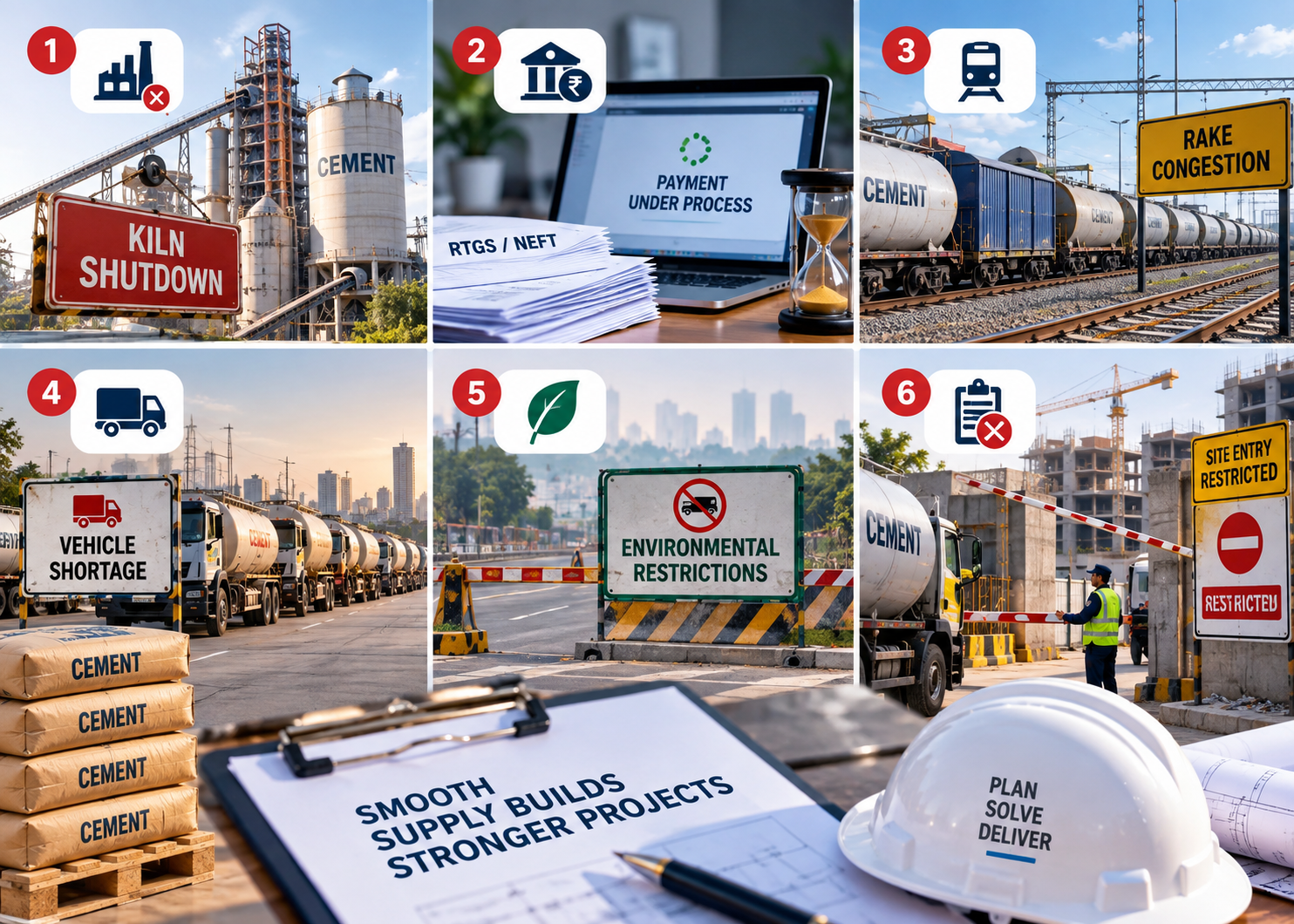
Top 6 Root Causes of Cement Delivery Stoppages

1. Plant Kiln Shutdowns & Clinker Deficits

Integrated cement plants operate continuously. When a major kiln undergoes routine refractories relining or suffers a breakdown, clinker availability drops, and grinding units halt dispatching.

2. Bank Payment Reflection Latency in SAP

RTGS/NEFT payments made after 3:30 PM may take hours to map to your virtual account in the manufacturer's ERP. If the account displays zero credit balance at midnight, loading slips will not generate.

3. Railway Rake Siding Congestion

During peak infrastructure quarters, railway goods sheds get heavily congested. If rakes are queued, siding cranes cannot offload, stalling secondary road vehicle pickups.

4. Bulker & 40 MT Trailer Scarcity

Specialized 30-35 MT bulk cement tankers are limited. If manufacturing plants prioritize mega-highway projects, RMC plants experience acute tanker allocation shortages.

5. Environmental & GRAP Bans

In Delhi NCR and winter northern zones, Graded Response Action Plan (GRAP-III & IV) halts diesel truck movement and non-essential construction dispatches on short notice.

6. Transporter Blacklisting from Site Detention

If a construction site takes more than 12 hours to offload a vehicle, transport unions charge heavy detention fees or refuse to take further loads to that specific pin code.

The Multi-Plant Matcon Advantage:

Because Matcon maintains direct institutional tie-ups across multiple Tier-1 manufacturers (UltraTech, JK Cement, JSW, Ambuja, etc.), if one mother plant suffers a kiln shutdown or trailer shortage, we can immediately route alternative supply from another pre-approved brand or secondary grinding unit, guaranteeing non-stop site continuity.

RMC SPECIALIZATION INDUSTRIAL SUPPLY

How RMC Plants Should Plan Cement Procurement

Strategic procurement frameworks for ready-mix concrete plants balancing bulk tanker dispatches, buffer storage, and consistent grade chemistry.

RMC Plant Cement Procurement

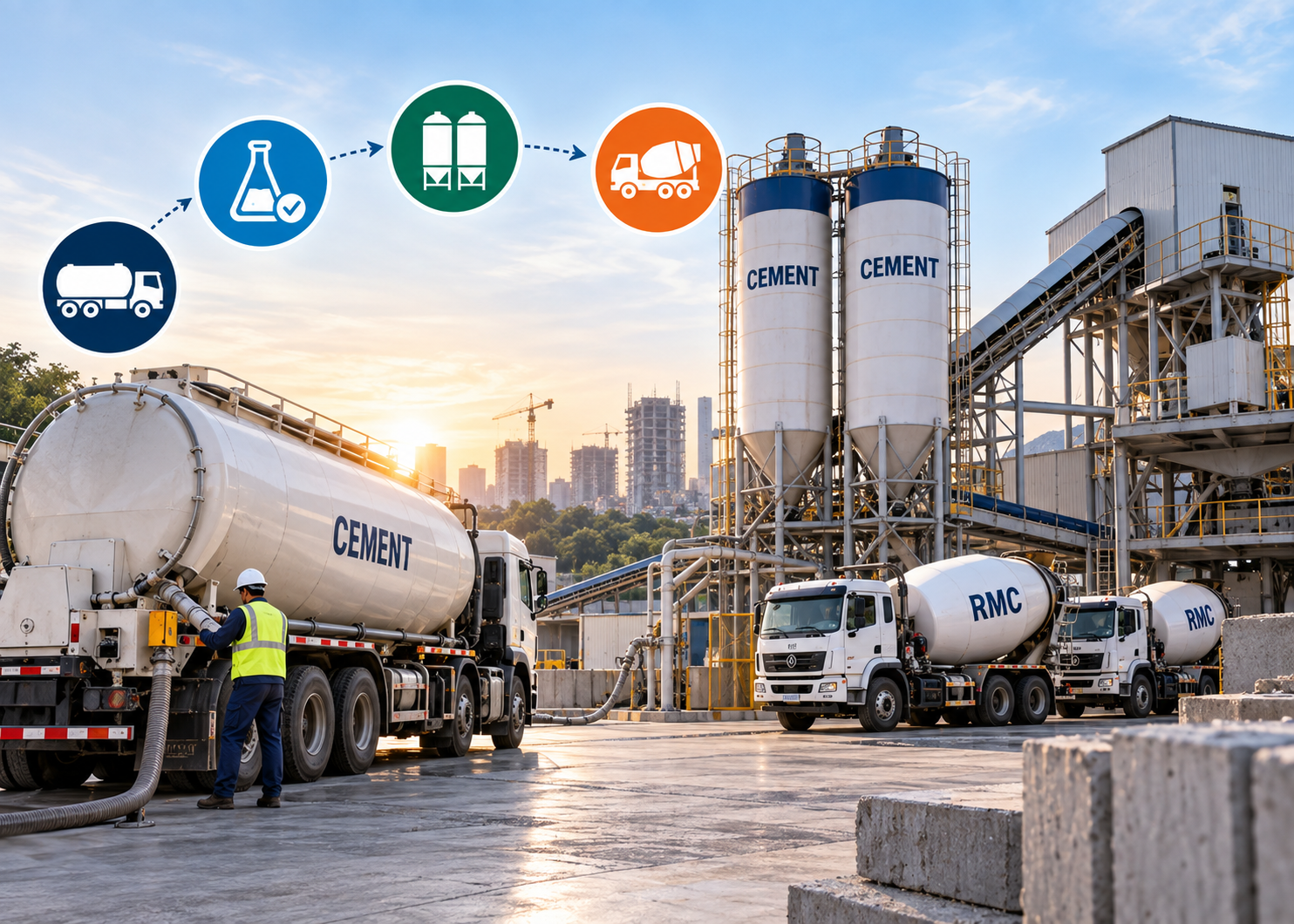
Ready-Mix Concrete (RMC) plants operate in high-volume, hyper-competitive markets with razor-thin operational margins. A commercial batching plant producing $60\text{ m}^3$ to $120\text{ m}^3$ of concrete per hour consumes between 18 to 35 metric tons of cement every hour of operation. For RMC owners and commercial directors, cement procurement is not just another purchasing function—it is the single largest determinant of plant profitability and customer retention.

Key Pillars for RMC Cement Procurement Excellence

1. 100% Bulk Tanker Logistics Over Bagged Cement

Except for specialty white cement or microsilica admixtures, modern RMC plants rely exclusively on loose bulk cement transported in pressurized pneumatic tankers. Bulk sourcing eliminates packaging costs (saving ₹120-₹200 per MT), eliminates bag tear and burst loss (typically 1.5-2%), and removes manual labor costs for de-bagging. Unloading a 30 MT tanker takes just 45-60 minutes using the plant compressor.

2. Chemical Consistency & Admixture Optimization

RMC mix designs rely heavily on polycarboxylate ether (PCE) based superplasticizers to achieve 150-180 mm slump retention over 2-3 hours of road transit. If a cement supplier shifts clinker sources, fluctuations in tricalcium aluminate ($C_3A$) and equivalent alkalis cause sudden slump loss or flash setting in transit mixers. Sourcing must guarantee consistent clinker chemistry from single mother plants.

3. Silo Management & Rolling Inventory

A two-silo setup ($2 \times 60\text{ MT}$ or $2 \times 100\text{ MT}$) allows an RMC plant to simultaneously store OPC 53 for high-grade commercial pours (M35 to M50) and fly ash/PPC for non-structural applications. Maintain a minimum rolling stock of 60 MT at all times to absorb highway traffic shocks.

Matcon's Dedicated Bulker Lineup Service for RMC Plants:

We provide dedicated bulker fleet line-ups from manufacturer plants, scheduled for overnight transit so tankers arrive at your silos between 4:00 AM and 6:00 AM. This guarantees your batching plant starts daily concrete dispatch with completely full silos every single morning.

STRATEGIC SELECTION BRAND ADVISORY

Choosing a Cement Brand for a New Project

Key factors for developers and EPC contractors when evaluating plant distance, manufacturer reliability, BIS standards, and consultant approvals.

Choosing a Cement Brand

With dozens of national and regional cement manufacturers operating across India, developers often face aggressive marketing claims from competing brand representatives. Selecting the brand for a 500,000 sq.ft. commercial development or township project requires evaluating technical compliance, structural consultant approval, logistics distance, and commercial flexibility.

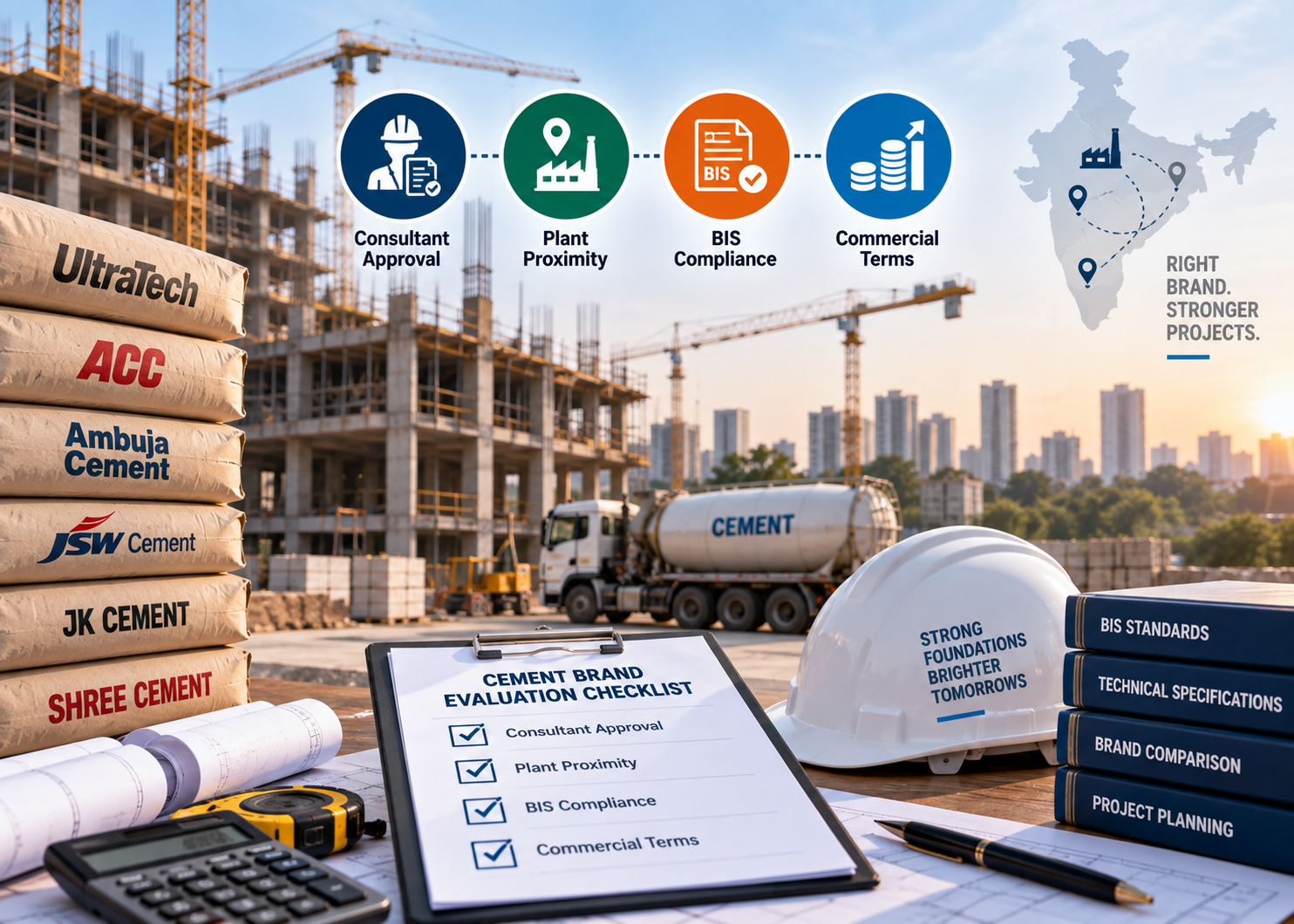
The 4-Step Brand Evaluation Matrix

1. Structural Consultant Approval List

Every commercial tender or high-rise project includes a list of pre-approved makes. Tier-1 brands (UltraTech, JK Cement, JSW, Ambuja, ACC, Shree) enjoy universal consultant approval, avoiding lengthy re-approval paperwork.

2. Grinding Unit & Plant Proximity

Select a brand with an integrated plant or grinding unit within 150 to 250 km of your site. Long transit distances (>500 km) multiply freight costs and expose your project to toll bottlenecks and highway breakdowns.

3. Clinker Uniformity & BIS Compliance

Verify that the manufacturer owns captive limestone mines with computerized clinker pyroprocessing. Captive mining ensures zero variation in lime saturation factor (LSF) and compressive strength throughout year-long pours.

4. Commercial Terms & Volume Rebates

Compare the net landing rates and monthly volume discount brackets. Some brands provide highly competitive non-trade institutional pricing when bundled with long-term quantity commitments.

The Multi-Brand Pre-Approval Strategy:

Never lock your tender into a single brand. Matcon assists developers in getting 2 to 3 Tier-1 cement brands officially pre-approved by their structural consultants prior to groundbreaking. Having multiple approved brands creates healthy price competition and guarantees continuous supply security.

QUALITY ASSURANCE LAB TESTING

Understanding Cement Samples, Testing and Mix-Design Approval

Step-by-step guide to cube compressive strength tests, fineness, consistency analysis, manufacturer test certificates (MTC), and lab approvals.

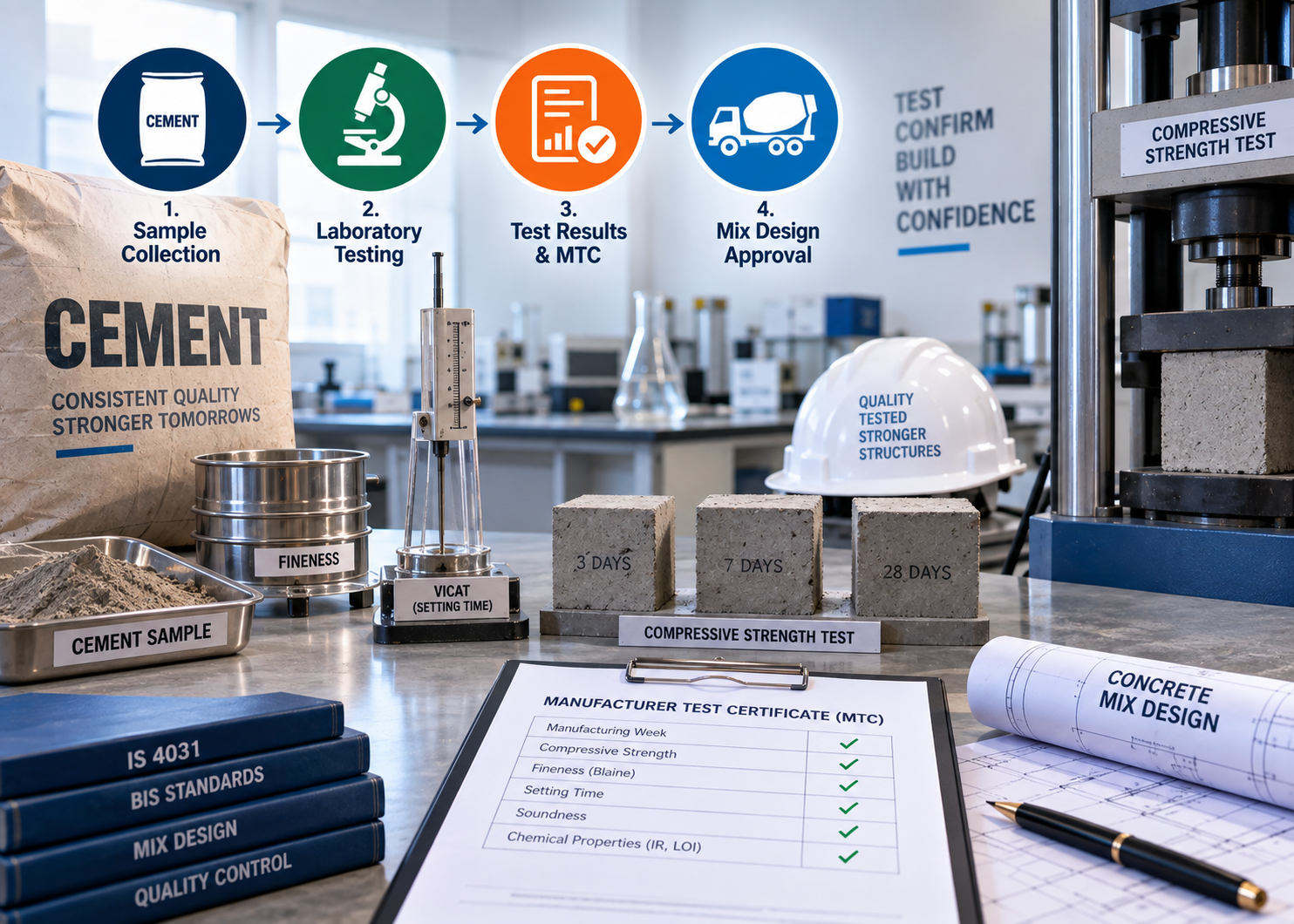
Cement Testing and Mix Design

Before an EPC contractor or builder can commence structural concreting on an institutional project, independent NABL-accredited laboratory test reports and formal concrete trial mix designs (e.g. M25, M30, M40, M50) must be submitted to the project management consultant (PMC). Understanding how samples are extracted, tested, and certified protects sites from compliance rejections and structural non-conformances.

Standard Physical Tests Under Bureau of Indian Standards (BIS)

  1. Compressive Strength Test (IS 4031 Part 6): Standard 70.6 mm mortar cubes prepared with 1 part cement and 3 parts Ennore standard sand at specified water ratio. Tested at 72 hours (3 days), 168 hours (7 days), and 672 hours (28 days). For OPC 53, values must achieve $\ge 27\text{ MPa}$, $\ge 37\text{ MPa}$, and $\ge 53\text{ MPa}$ respectively.
  2. Initial & Final Setting Time (IS 4031 Part 5): Measured using standard Vicat apparatus with needle penetration. Initial setting time must not be less than 30 minutes (allowing handling, transport, and pouring), and final setting time must not exceed 600 minutes (10 hours).
  3. Fineness by Blaine Air Permeability (IS 4031 Part 2): Measures the specific surface area of cement particles. Higher fineness accelerates early hydration. Standard limits: Minimum $225\text{ m}^2/\text{kg}$ for OPC and minimum $300\text{ m}^2/\text{kg}$ for PPC.
  4. Soundness Test (IS 4031 Part 3): Conducted via Le Chatelier mould and Autoclave expansion tests to detect excess free unburnt lime ($CaO$) or magnesia ($MgO$) that can cause disruptive volumetric expansion inside hardened concrete. Expansion must not exceed 10 mm.

What to Check on the Manufacturer Test Certificate (MTC)

Every truckload of institutional cement carries an official computer-generated Manufacturer Test Certificate (MTC) / Mill Test Report corresponding to that exact manufacturing batch or silo run. Always check:

  • Week Number of manufacturing (cement older than 90 days from manufacture date requires mandatory re-testing before structural use as per IS codes).
  • Insoluble Residue (IR) and Loss on Ignition (LOI) to verify purity.
  • Batch 28-day historical strength certification from the mother plant lab.
Matcon's Complete Quality Assurance Protocol:

Matcon coordinates official plant test samples directly from fresh grinding batches for your initial trial mix designs. With every dispatched trailer, we deliver the authentic manufacturer batch MTC directly to your site quality engineer, ensuring 100% smooth client and consultant billing approvals.

NEED BULK CEMENT SUPPLY?

Partner with India's Dedicated Institutional Cement Liaison

Matcon India connects builders, contractors, RMC plants and infrastructure developers with leading cement manufacturers for dependable institutional supply, competitive project rates, customer code opening, and timely factory-to-site dispatches.

Quick Cement Enquiry